
HOW I WORK
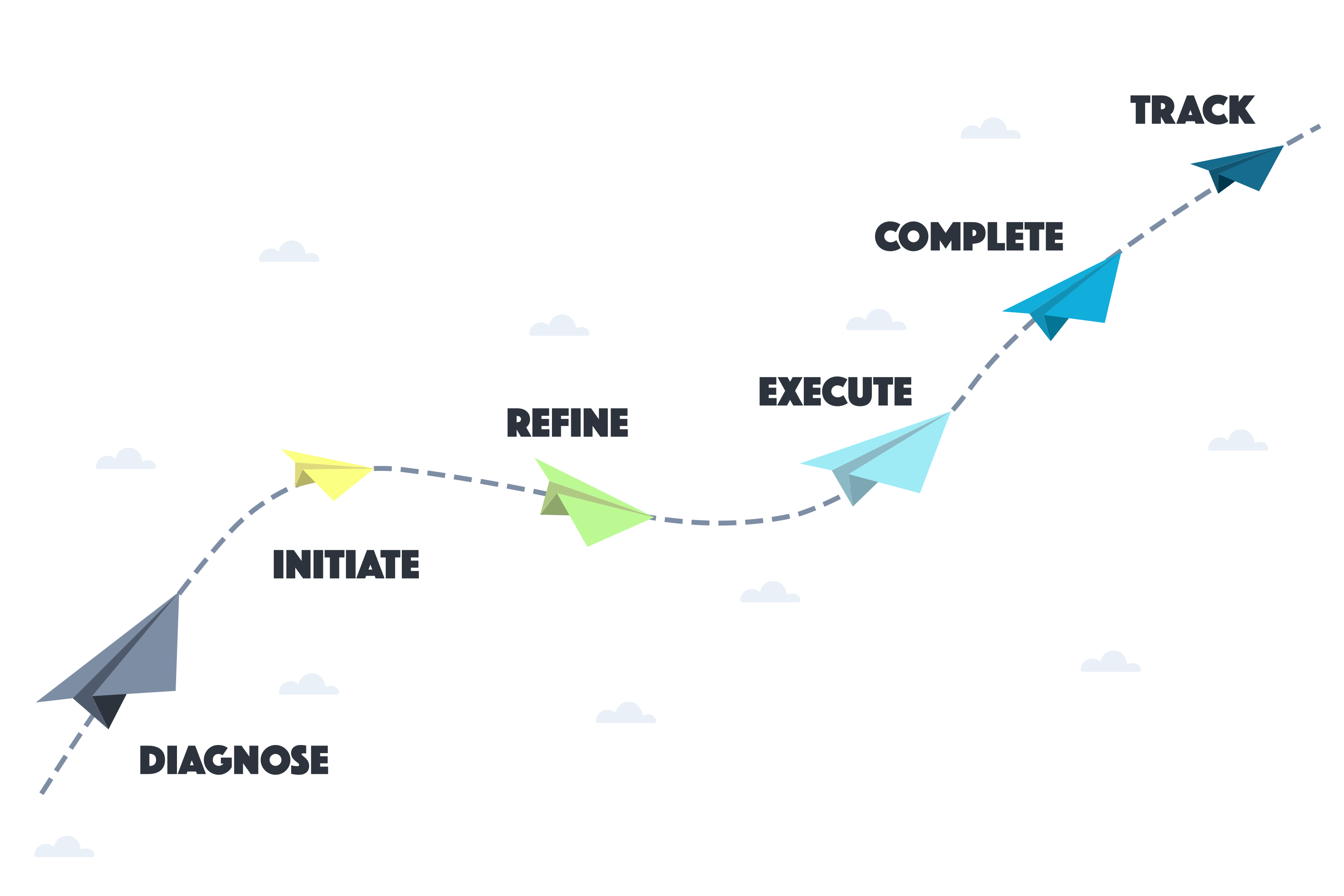
DIRECT
One architecture.
Six phases.
No two engagements alike.
A two-day diagnostic and a six-month engagement both run on DIRECT. What changes is how much of the architecture gets activated and how deep each phase goes.
Every organization’s constraint is different, so the depth, sequence, and selection of activities within each phase gets built specifically for what the situation actually needs.
What stays the same is the rigor. Nothing gets skipped, and nothing gets built before the real constraint is named. That’s what makes it possible to move quickly without guessing at what to do next.
DIAGNOSE: Find the real constraint that’s blocking the growth potential.
The fastest path through any complex problem runs directly through an honest diagnosis. What looks like a team problem is usually a decision rights problem. What looks like a strategy problem is usually an execution architecture problem. What looks like a communication problem is usually a structural clarity problem.
Some diagnostic work starts before an engagement is formally underway. A Discovery Conversation or Strategic Business Review can open this phase with no investment required. The depth of what follows depends on what the situation needs and how far the diagnosis has already gone.
Whatever the entry point, the goal is the same: find the real constraint before anyone builds anything toward solving the wrong one.

INITIATE: Create a path that addresses the real constraint and builds towards the goal.
Once the real constraint is visible, everything else needs to align around it before anything is built. Investment, timeline, team, gaps, and how we move forward if some of those gaps haven’t closed yet when we start.
Whether this is a first conversation or a continuation of diagnostic work already underway, this is where shared clarity replaces assumption. A named goal. A done condition everyone can point to. Ownership inside the organization made explicit rather than implied.
Most projects that fail don’t fail in execution. They fail here, when everyone assumed they were aligned and nobody checked.
REFINE: Give bottlenecks on the path what they need to move towards faster growth.
This is where the intervention gets built. By defining what it needs to be and pressure testing it before it’s relied on.
The right people get brought into the work. Systems and processes get designed. Tools get built by the client’s team with collaborative facilitation, so that when the engagement moves forward, the team can run what they built without needing anyone to explain it.
Every session has a purpose and an output. A decision, clarity on why a decision keeps getting avoided, or homework for the client, the team, or a partner. What it never is activity without a destination. Every step builds toward the goal without leaving structural debt behind
EXECUTE: Move forward with numbers that create accountability and address what’s not working before things break.
This is where wound analytics gets replaced by something built for purpose. Instead of measuring where it hurts, we’re measuring whether the real constraint is actually loosening. The KPIs and KRIs established here connect directly to what Diagnose found, not to whatever was being tracked before.
The heavy lifting is done. What starts now is the cadence, working sessions, or an internal rhythm the team runs checking in at defined intervals. Either way, the accountability structure is explicit and the metrics are live.
Most organizations have goals. Fewer have a clear line between the goal and what someone does differently on a Tuesday morning because of it. Execute builds that line, and builds the system to look back on it, prove what moved, and improve what didn’t.
COMPLETE: Goals have been met. Processes keep it stable. Business grows. Teams turn to tackle the next challenge hindering growth.
A formal session with a defined agenda. The done condition gets reviewed against what was agreed at the start. What moved and what the team now owns gets stated plainly. A 60-day check-in gets scheduled before anyone leaves the room.
This isn’t a handoff and a hope. The engagement closes cleanly because the process was designed from day one to make sure it could. Every stage gate was hit. Every hard conversation happened when it needed to. The team doesn’t just have a result, they have the understanding to keep running it.
There’s no autopilot in business. Accomplishing something well just surfaces the next constraint worth addressing. Complete ends this chapter cleanly so the team can move toward that one without carrying unfinished business from this one.

TRACK: The growth alarm is the warranty. Most engagements don’t offer one.
Most engagements like this end with a document and a goodbye. This one ends with a system designed to keep working after Frank leaves the room.
Everything built during the engagement, the accountability layer, the decision frameworks, the KPIs and KRIs connected to the real constraint, gets wired into the growth alarm. A forward-facing monitor that tracks momentum, flags drift before it becomes a crisis, and gives the information needed to pivot early instead of rebuild late.
This is what Frank stands behind. The process was designed from day one so every stage gate happened, every hard conversation was had, and every piece of work had the right people’s eyes on it before it was relied on. If something breaks later, it won’t be because the work wasn’t done. The growth alarm is the proof it held.
WHO THIS IS FOR
Leadership teams navigating a strategic pivot. Teams that have to get something right before it gets built, and know the brief isn’t there yet. Cross-functional initiatives that have lost momentum between the decision and the execution. Organizations that have invested heavily in a direction and need someone to assess what’s salvageable and what has to change. Founders and operators who have scaled into complexity that the original structure wasn’t built to hold.
The common thread isn’t industry or size. It’s that something capable is stuck and the people inside it have been there too long to see why.
START WITH A DIAGNOSIS
Before we get on a call, tell me what’s going on. The questions below are the same ones I’d ask in the first twenty minutes of a conversation. Answering them honestly takes about five minutes and gives us both something real to work from.
I read every submission personally. If there’s something worth exploring I’ll reach out within two business days.